|
|
|
|
|
|
Every year Gartner releases a chart that quietly shapes millions in enterprise buying decisions. This year the Magic Quadrant for Integration Platform as a Service matters more than usual. Not because of who is on it, but because of what it says about where enterprise technology is going.
Let me break it down the way I wish more people would. Plainly, and with the parts that actually matter. First, the money, because that is the part that tells you this is not a niche.
|
|
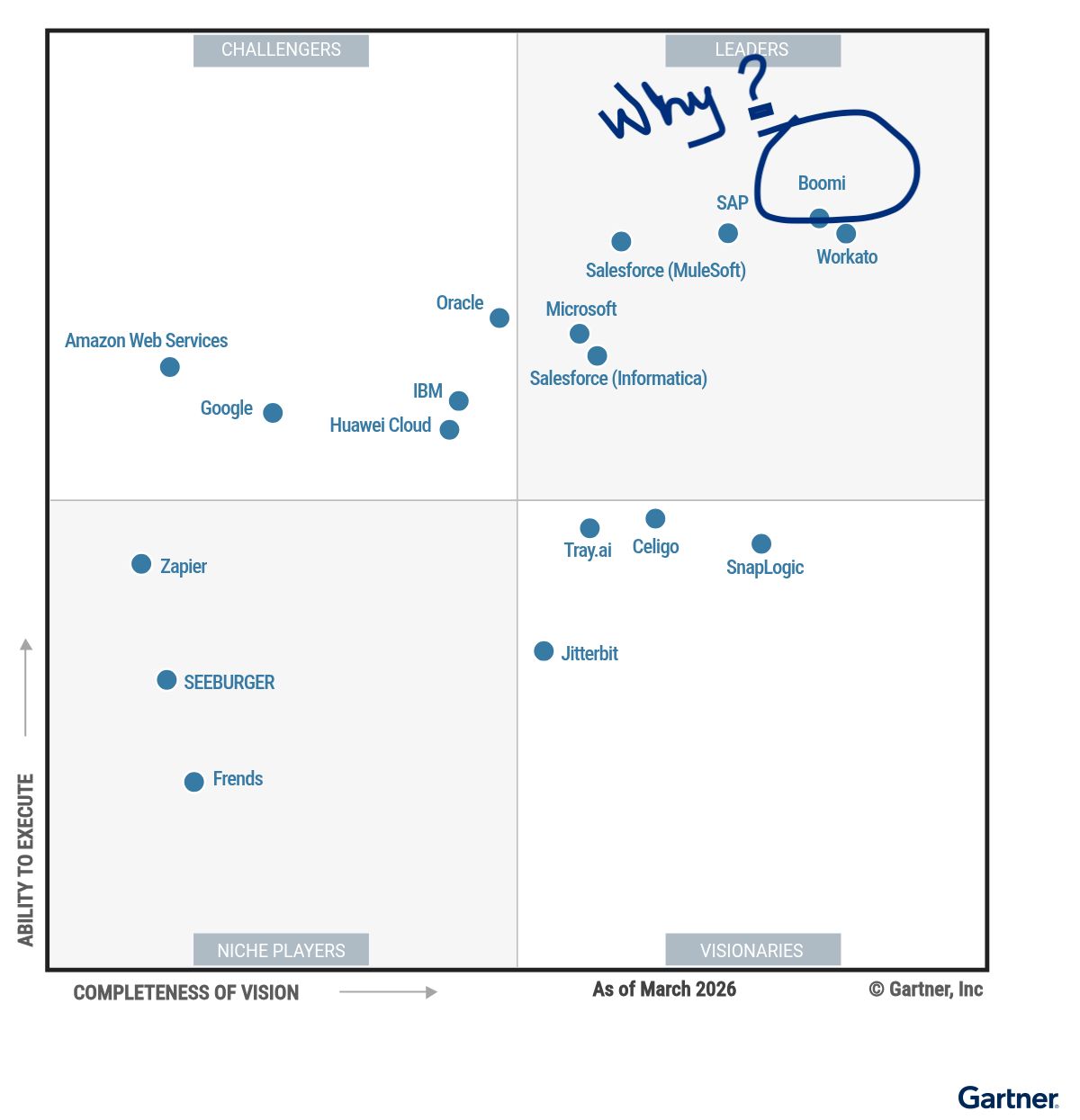
Figure 1 · Magic Quadrant for Integration Platform as a Service · Source: Gartner, 16 March 2026
|
$8.5B Market size in 2024 | 23.4% Growth in 2024 | $18B+ Forecast by 2029 |
iPaaS revenue · actual and forecast
$6.9B 2023 | $8.5B 2024 | $18B+ 2029 EST |
A market more than doubling in five years is not a feature. It is a foundation. As organizations rush into AI, low-code, and SaaS everywhere, they need a way to connect all of it. Integration is the layer that makes AI actually usable inside a business. Without clean, governed, connected data, even the best model produces nothing you can trust.
|
|
|
The four quadrants
What the Magic Quadrant actually is
Gartner placed 18 vendors on two axes. Ability to Execute on one side, Completeness of Vision on the other. That splits the market into four groups.
Execute + vision Leaders Boomi, SAP, Salesforce MuleSoft, Salesforce Informatica, Workato, Microsoft |
| Strong, narrower Challengers AWS, Google, Huawei Cloud, IBM, Oracle |
|
Ahead, smaller Visionaries Celigo, Jitterbit, SnapLogic, Tray.ai |
| Focused Niche Players Frends, SEEBURGER, Zapier |
|
|
| |
The story most people missed
Salesforce now sits in the Leaders quadrant twice
After acquiring Informatica in November 2025, Salesforce owns two separate iPaaS platforms, both Leaders. That signals consolidation at the top of the market. If you run MuleSoft or Informatica today, watch Salesforce’s roadmap closely to see how the two overlap and where investment goes.
|
|
|
|
What is changing
Five shifts every leader should understand
| 1 | AI-ready integration iPaaS is now the layer that gives AI agents safe, governed access to enterprise data. This is the number one theme of the report. |
|
| 2 | AI features are standard Flow generation, mapping, and testing by AI are no longer a differentiator. Everyone has them. Depth and governance separate winners. |
|
| 3 | One unifying fabric Buyers want one platform for apps, data, APIs, events, B2B, and AI workflows. Not six tools stitched together. |
|
| 4 | Data sovereignty Where data lives is now a board-level question. Regional control planes have become a real differentiator. |
|
| 5 | Different personas, different operating models Specialists, developers, and business users all integrate now. Vendors win by fitting the way your teams actually work, not just your tech stack. |
|
|
|
Why it keeps leading
Boomi, held up against those five shifts
Boomi is a Leader again. And when you measure the platform against what the market is actually rewarding, you can see exactly why.
It moved early on AI-ready integration. Teams can create and manage MCP servers, and Boomi Agentstudio handles AI agent management. That is the number one theme in the whole report, and Boomi is building directly in it while many vendors still call it a roadmap item. It kept the platform unified with single sign-on and one experience, and it goes deep by industry, from energy to higher education to manufacturing and retail.
✓ Why it leads | AI-native platform with MCP servers and Agentstudio | | Unified experience with single sign-on | | Deep industry focus and a large partner network | | Marketing that maps to what buyers care about |
|
|
! Watch points | Revenue still concentrated in North America | | Main platform control plane hosted only in the US | | Portfolio spread across different data centers | | Customer satisfaction has room to grow vs peers |
|
|
The pattern is what stands out. Boomi keeps doing the boring things well and the new things early. In a market moving this fast, staying a Leader is harder than becoming one.
|
|
On the ground · London
A little from the tour
The timing lined up well. I was on the ground at Boomi World Tour London, and the Magic Quadrant themes were not slides on a stage. They were the whole conversation.
The through line from the keynotes was simple. Connect the data, govern the agents, give enterprises control instead of chaos. The Agentstudio roadmap session pushed the agent management story from a pitch into a real plan. Build agents, govern them, orchestrate them, in one place.
The line that stuck with me came from a session on blending rules-based automation with AI reasoning. The point was that the key to AI ROI is not the model. It is data readiness. I have said this on the show for two years. Hearing a vendor build a product strategy around it, not a slide, was the moment the whole event made sense.
|
|
Integration used to be the part nobody wanted to talk about. In the AI era, it might be the part that decides who wins.
|
|
That is the real story behind a dot on a chart. Not the position. The work behind it, and the market forces pulling everyone forward.
I brought back far more from these two days than fits in one issue. The interviews and deeper breakdowns are coming on The Ravit Show.
Until the next one,
Ravit
|
|
|
Data and AI, straight from the people building it. Interviews, on-ground event coverage, and analysis that stays clear over clever.
Learn more about Boomi
Market figures and vendor positioning referenced from Gartner, Magic Quadrant for Integration Platform as a Service, 16 March 2026. Gartner does not endorse any vendor, product, or service depicted here. Independent commentary by The Ravit Show.
|
|